Bible Study Methods

Observations - Part 1

Lexical, Syntactical, and Grammatical Observations

Words

Words serves as the foundational architecture through which an author articulates complex ideas, necessitating that each word be evaluated strictly within its surrounding framework since contextual usage ultimately dictates precise meaning. While standard dictionaries and lexicons are invaluable for establishing the objective denotation of a term, dedicated word studies allow researchers to isolate and decipher the nuanced, specialized meaning of a specific vocabulary choice within its unique textual environment.

Connectives

Identifying connectives is a critical analytical step, as these linguistic conduits synthesize disparate textual elements and establish the structural trajectory of the author's overarching argument. Acting as the semantic skeleton of the text, these words and verbal phrases govern vital communicative frameworks, including contrasts, comparisons, logical progressions, and causal relationships, with emphatic forms (indeed, only, verily), local markers (in, where), conditions (if), reasons (because, for, since), results (so that, so then, then, therefore, wherefore), sequential facts (and, first, or), and temporal indicators (after, before, now, then, until, when, while) establishing distinct arrangements. For example, logical comparisons draw associations between parallel concepts, figures, or actions as seen in Romans 5:12-21 and Hebrews 5, whereas logical contrasts explicitly disassociate ideas, individuals, or behaviors, as demonstrated in 1 John 1:5.

Subjects and Objects

Syntactical clarity requires a systematic determination of the primary subject within a clause, followed by the careful identification of its corresponding direct objects, indirect objects, and other substantiating noun components that receive or interface with the core focus.

Predicates

Analyzing the predicate requires isolating the principal verb alongside any auxiliary or helping verbs, while simultaneously identifying verbal derivatives such as gerunds, participles, and infinitives that articulate actions or state relationships concerning the subject. This grammatical relationship often extends to an object and can be manifested through various voices and properties, including active, passive, transitive, or intransitive configurations.

Patterns, Repetition, and Word Order

Textual patterns frequently emerge through the intentional use of uniform verb tenses, explicit word repetitions, or unique structural configurations like acrostics where sentences initiate with consecutive letters of the alphabet, exemplified by the coordinating structure and repeated use of "and that" in 1 Corinthians 15:3-10. Furthermore, deliberate deviations from standard syntax or conventional word order typically signal a rhetorical shift designed to place heightened emphasis on a specific concept, a phenomenon explored thoroughly in Roy Zuck’s Basic Bible Interpretation (121) under “Word order and Repetition.”

Comparisons and Contrasts

Authors frequently deploy comparisons through figurative language like similes, metaphors, parables, and allegories—where parables operate as extended similes and allegories function as sustained metaphors—to illuminate similarities between concepts. Conversely, distinctions are highlighted through contrasts, which are routinely flagged by adversative conjunctions like "but" or "rather," or expressed covertly through literary devices such as irony, a paradigm detailed in Howard Hendricks’ Living by the Book (158) in the chapter titled “Things that are alike and unlike.”

Commands and Exhortations

Commands represent authoritative, imperative directives mandating the execution or cessation of a specific action, historically indicated in linguistic analysis by the Greek imperative verb tense, whereas exhortations function as urgent, persuasive appeals or entreaties regarding behavior rather than absolute dictates.

Commands and Exhortations

Commands represent authoritative, imperative directives mandating the execution or cessation of a specific action, historically indicated in linguistic analysis by the Greek imperative verb tense, whereas exhortations function as urgent, persuasive appeals or entreaties regarding behavior rather than absolute dictates.

prepositions

Prepositions and Prepositional Phrases

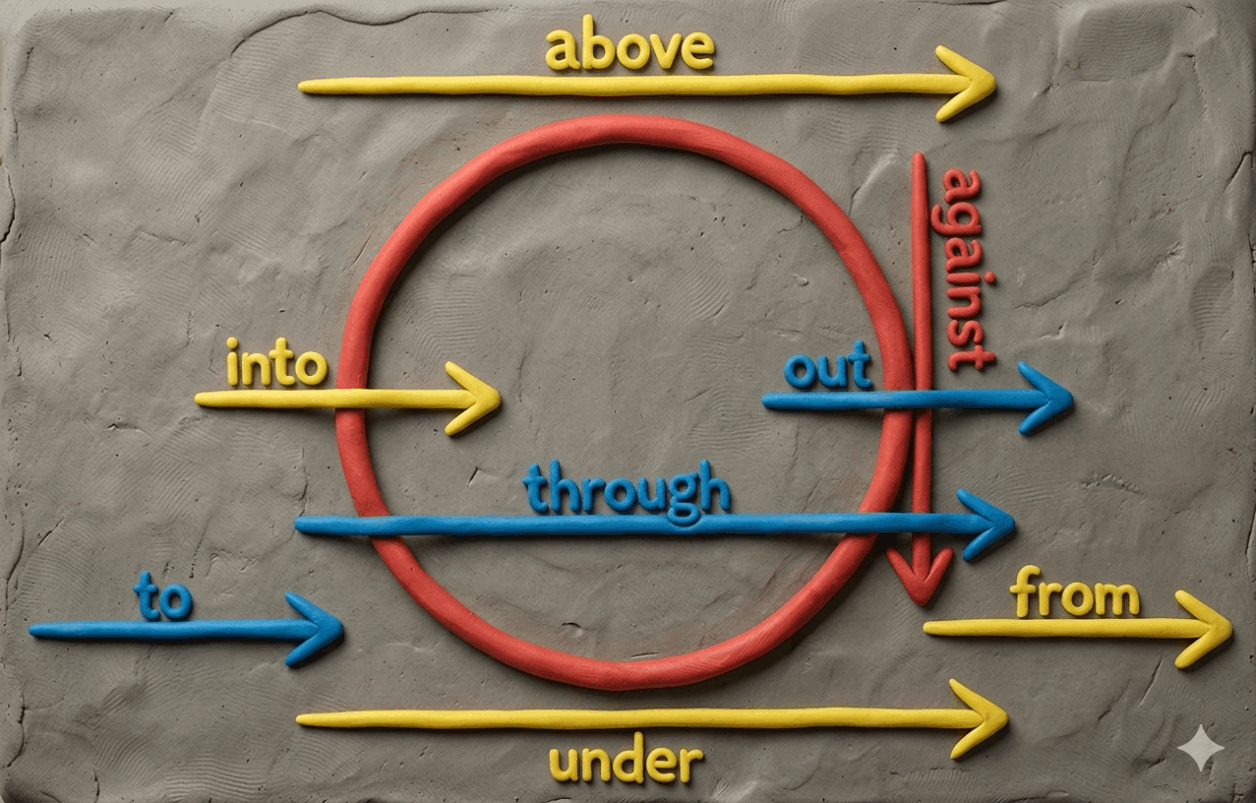
Prepositions are ubiquitous linguistic tools that fundamentally convey spatial, temporal, or logical relationships, generating prepositional phrases that modify their respective subjects to communicate intricate situational dynamics through terms such as from, out of, in, into, to, toward, through, after, around, above, under, against, and alongside.

Adjectives, Adverbs, and Genitives

Modifiers refine textual meaning by utilizing adjectives to describe or qualify the attributes of nouns, employing adverbs to modify and add dimension to verbs, and leveraging genitives, which are often possessive in nature, as modifying words or phrases that restrict or define another noun, as demonstrated in Ephesians 6:17 with the phrase “the sword of the Spirit.”

Articles

The presence and type of a noun's article drastically alter its semantic impact, as shifting between the indefinite article "a" and the definite article "the" fundamentally changes a concept from an ambiguous, undefined item to a specific, uniquely identified entity.

Textual Content Observations

Subject/Purpose/Theme

To properly analyze a text, one must first identify its core subject matter and underlying objective. Determining the overarching purpose involves tracing how the central thesis originates within initial sentences or clauses and subsequently expands into a fully realized thematic framework.

Style, Voice, and Vocabulary

Every author possesses a distinct voice and lexicon that fundamentally shapes how their message is delivered and understood. Recognizing this authorial voice illuminates the writer's rhetorical purpose, as evidenced by the contrasting emotional tones of biblical books like the Song of Solomon and Lamentations, or the theological focus of the Gospel of John compared to the historical approach of Luke. Furthermore, analyzing specialized vocabulary, such as military, legal, or medical terminology, clarifies the precise concepts the author intends to convey, while identifying the literary genre provides essential context for interpretation.

Structure and Allotment

Literary architecture plays a critical role in meaning, particularly in structural devices like the acrostics and chiasms found throughout Hebrew poetry. The proportion of text an author dedicates to a specific topic serves as a reliable indicator of its significance, as seminal themes naturally demand greater structural space and analytical focus. It is vital to recognize that modern chapter and verse divisions, along with contemporary headings, were absent in ancient manuscripts, save for the original subtitles in the Psalms, meaning that relying strictly on these modern boundaries can distort the narrative flow, especially when transitions occur abruptly mid-thought as seen in Colossians 4:1.

Contextual Content Observations

Literary Context

Analyzing a scriptural text necessitates a profound understanding of its structural placement within the broader canon of sacred scripture. The definitive interpretation of any given passage invariably aligns with the core meaning established by its surrounding literary environment. By evaluating this broader structural setting, readers significantly enhance their comprehension of the author's overarching thematic message. For a more comprehensive exploration of this hermeneutical principle, consult Klein, Blomberg, and Hubbard’s Introduction to Biblical Interpretation, specifically the section titled “Literary Context” (156).

Historical Context

Determining the historical backdrop of a biblical book remains indispensable for objective analysis, requiring scholars to investigate fundamental inquiries regarding its geographic origin, chronological timeline, target audience, and motivating purpose, alongside the prevailing political landscape of Israel and the immediate sociological challenges confronting its initial recipients. Reconstructing this historical milieu provides readers with the critical capacity to cognitively immerse themselves into the exact reality of the original audience, a process heavily facilitated by scholarly tools like study Bibles, theological dictionaries, specialized encyclopedias, commentaries, and ancient customs manuals. For example, a thorough examination of Acts 16:16 requires an intimate awareness of Athenian Greek culture, specifically contrasting the classical emphasis on logic, rhetoric, and philosophical debate against the traditional Jewish expectation for miraculous signs and wonders. Similarly, interpreting Luke 2:1 and subsequent verses demands a strict historical evaluation of Roman administrative practices, notably exemplified by the secular records detailing the Census of Quirinius. To investigate these methods further, refer to the detailed analysis in Klein, Blomberg, and Hubbard’s Introduction to Biblical Interpretation under “Historical Cultural Background” (172), as well as Henry A. Virkler’s Hermeneutics within the chapter on “Historical Cultural and Contextual Analysis” (75).

Cultural Context

While historical analysis maps the overarching societal timeline, evaluating cultural context isolates the precise customs, localized behavioral norms, and idioms that an author utilizes to convey nuanced meaning. Though cultural idiosyncrasies are not uniformly central to every biblical pericope, they frequently dictate the primary meaning of specific narratives, manifesting either as physical rituals or culture-specific linguistic structures that can be cross-referenced using specialized historical lexicons, encyclopedias, and commentaries. A prime illustration occurs in John 4:1-42, where a cultural interrogation reveals that ancient Jews systematically avoided traversing Samaria, and that Jewish men strictly abstained from public discourse with unfamiliar women, especially Samaritans, due to deep-seated ethno-religious animosity. Likewise, when parsing texts like Matthew 22 or John 2, reconstructing the sophisticated customs of ancient Jewish weddings, including ceremonial technicalities, lengthy domestic preparations, communal feasts, and the rigid expectations placed upon the bridal party and their guests, furnishes essential interpretive clarity.

Geographic Context

Physical geography exerts a profound influence on biblical composition, meaning that a deficiency in topographical knowledge can inadvertently obscure an author's intentional symbolism or introduce modern interpretive fallacies. Scholars must actively familiarize themselves with ancient urban centers, regional infrastructure, mountain ranges, and hydrological features, utilizing comprehensive biblical atlases and cartographic tools to illuminate the text. This geographical reality is profoundly illustrated in Psalms 120-134, traditionally designated as the "Songs of Ascent," which directly reflect the literal, uphill physical trek that ancient pilgrims underwent when traveling to the elevated city of Jerusalem.

 Theological Context

Theological context examines the existential and covenantal relationships between biblical figures and God, tracking the continuous development of doctrinal concepts that surround and inform a given text. Formulating a rigorous, textually grounded Biblical Theology requires meticulous analytical care and a firm grasp of foundational hermeneutical principles, including Progressive Revelation, the rule that Scripture interprets Scripture, and the historical clarity or Perspicuity of Scripture. For example, the Apostle Paul's rigorous intellectual training as a Pharisee profoundly shapes the doctrinal architecture, rhetorical arguments, and theological frameworks observed throughout his New Testament epistles. Ultimately, while exegesis relies on diverse observational data, categorizing these data points into literary, historical, cultural, geographic, and theological domains serves to systematically organize complex textual information into an accessible and coherent framework.

map

Diagramming the text

Purpose of diagramming

The primary objective of sentence diagramming is to discern and analyze structural relationships within a text. Visualizing the syntax allows readers to uncover both the author's underlying intent and the precise semantic connections between individual words.

This analytical tool becomes indispensable when encountering complex, labyrinthine syntax (the relationships of words to one another). For instance, the Apostle Peter explicitly notes that some of the Apostle Paul's writings are difficult to comprehend (2 Pet 3:15-16). This difficulty often stems from Paul's propensity for extended syntax; in the original Greek, Ephesians 1:3-14 constitutes a single, unbroken sentence spanning several verses. Without structural analysis, readers risk losing sight of the overarching argument by becoming overwhelmed by individual clauses; effectively failing to see the forest for the trees.

Ultimately, diagramming serves to demystify complex and obscure passages. It is not a mandatory exercise for every literary text, as historical narratives generally employ straightforward, chronological language that requires no deep syntactic parsing. However, when navigating dense theological or philosophical arguments, sentence diagramming serves as an effective mechanism to eliminate ambiguity and clarify textual meaning.

Diagramming the Text

To construct an accurate diagram, you must first identify the specific grammatical components operating within the verse. Comprehensive textual comprehension requires a foundational mastery of the parts of speech, as one cannot fully grasp the scope of a message without isolating the structural building blocks of communication.

There are multiple methods of diagramming. Two main approaches are block diagramming and line diagramming.

Block Diagramming

Block Diagramming

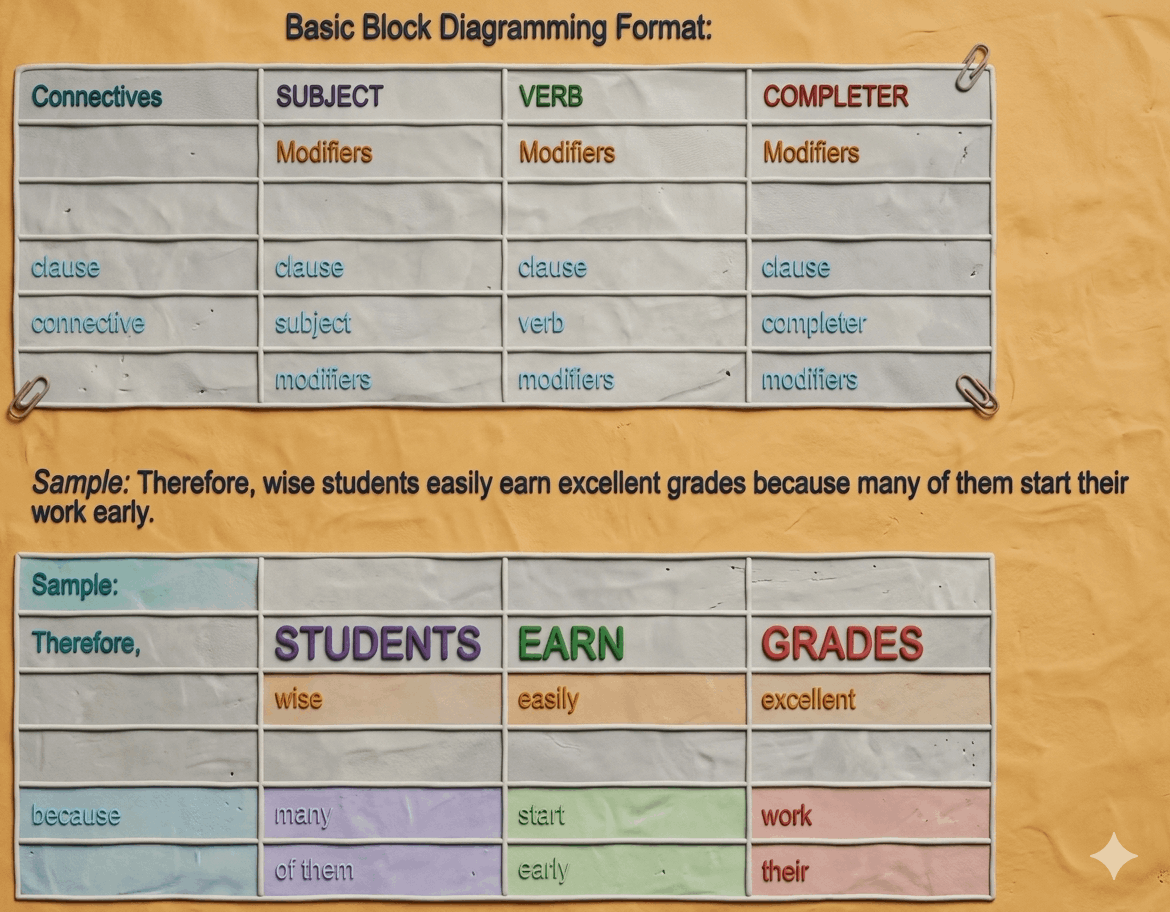
Block diagramming is a specific methodology that utilizes columns and structural blocks to visually isolate and align related words and phrases. Historically, scholars achieved this layout manually using physical indentation and tabs. However, the advent of digital publishing software has modernized this practice, making it significantly more efficient to organize syntactic units using digital tables and grids.

block

Determining Main Statements

The initial step in structural analysis is to isolate the subject of the sentence, which identifies the agent performing or receiving the action. Following this, identifying the main verb is critical; independent verbs serve as the structural anchor of the entire sentence, while dependent clauses and verbals function merely to modify, restrict, or expand upon the core action presented by that primary verb. Because dependent clauses and verbals lack complete grammatical autonomy, they cannot stand alone as complete sentences. Your ultimate objective during this stage is to distill the sentence down to its foundational, skeletal proposition to understand the basic idea being communicated.

When analyzing biblical languages, it is important to note that subjects and "completers" may be implicit or embedded directly within the verbal morphology. While English sentences rarely feature an implied main verb, Hebrew and Greek frequently omit certain verbs—such as the copula "to be"—leaving them entirely implicit. Furthermore, an implied subject is one that is omitted from the explicit text but remains clearly understood by the reader, typically supplied by the immediate grammatical person of the verb or the preceding literary context.  

The Completer

The completer, traditionally known in formal syntax as the predicate or complement, is the structural component of the sentence that fulfills and rounds out the conceptual idea initiated by the subject. Without this element, the transitive action of the verb remains suspended and incomplete. In standard grammatical construction, the primary core of the completer is most frequently realized as the direct object, which directly receives the action exerted by the principal verb.

Modifiers

Modifiers are secondary linguistic elements that qualify, restrict, or embellish the primary components of a sentence, adding vital nuance to the core message. These elements generally operate on two structural levels:

Words: This category includes adjectives, which qualify nouns and pronouns, and adverbs, which modify verbs, adjectives, or other adverbs to specify time, manner, place, or degree.

Phrases: These are multi-word clusters lacking a subject-verb pairing, most notably prepositional phrases, that function adjectivaly or adverbially to establish spatial, temporal, or causal relationships within the text.  

Clauses

Clauses are distinct syntactic units that possess their own structural integrity, explicitly containing both a subject and a predicate. In advanced textual analysis, you will occasionally encounter clauses featuring verbs with implied subjects, where the actor is understood through context or verbal inflection rather than explicit statement. Crucially, a dependent or subordinate clause cannot stand alone as an independent thought; it relies entirely upon its relationship to a main clause to derive its full semantic validity.

Line Diagramming
Line diagramming is a structural methodology. It utilizes a network of intersecting horizontal, vertical, and slanted lines. These lines visually map the exact syntactic and semantic relationships between words.

For those interested in applying these visual techniques to scriptural analysis, executing a web search for "Bible diagramming" will yield an abundance of specialized scholarly and practical resources.

The historical trajectory of line diagramming in English grammar is rich and well-documented:
  • Historical Origins. The online essay The Early History of Sentence Diagrams provides comprehensive context on how this pedagogical tool evolved. Visual analysis originally emerged in the mid-nineteenth century with S.W. Clark's 1847 balloon-style diagrams. However, Alonzo Reed and Brainerd Kellogg heavily refined the discipline in the 1870s. Their system successfully shifted classroom instruction away from tedious, word-by-word oral parsing toward a top-down, hierarchical understanding of sentence architecture.
  • Antiquated Handbook. To examine a rigorous, early twentieth-century approach to English syntax, you can review Henry C. Edgar’s 1915 manual, Sentence Analysis by Diagram: A Handbook for the Rapid Review of English Syntax.
  • Modern Adaptation. To observe how these classical techniques are adapted for contemporary students, the Grammar Revolution platform offers an excellent modern example of streamlined grammar exercises and step-by-step instructional guides.
books

Word Studies

The Scriptures were originally composed in Hebrew, Greek, and very small portion in Aramaic. In the process of translating God’s word, scholars endeavor to find accurate linguistic vehicles to communicate the precise meaning of the source text.

Translation between distinct languages can be exceptionally difficult, particularly when one language possesses numerous words to express the subtle nuances of a subject, while the target language has very few. Consequently, a single source word may require multiple target words, entire phrases, or even a full sentence to convey its meaning. Furthermore, certain structural features of languages do not directly translate, such as the inflected nature of Greek or the modern system of English punctuation. Therefore, executing rigorous word studies allows a researcher to uncover layers of meaning that a concise, formal translation might fail to convey. 

Word Study: Decide on Word(s)

Word studies can easily seem overwhelming when approaching an extensive text filled with dense vocabulary. It is often necessary to isolate specific key terms that require clearer definition or deeper comprehension. Throughout this process, it is essential to remember that words ultimately derive their meaning from their immediate context.

An interlinear translation is a highly useful tool to help grasp a word and identify its original language counterpart. If a specific word is italicized in an English Bible, it indicates that there is no direct original language word that equates to it, meaning the translators added it for clarity or readability.

  • Nature of Words: They function as signs pointing to reality.
  • Semantic Range: Most words possess a broad range of potential meanings.
  • Historical Shifts: Word meanings inevitably evolve over time.
  • Syntactical Relationships: Meaning is heavily influenced by sentence structure.
  • Linguistic Nuance: One must recognize the unique nuances of the original language.
traffic

Word Study Process & Tools

Word Meaning: Denotations and Etymology

Utilize specialized reference tools to learn the full range of meanings for any given word. Beginning with a standard English dictionary can help a student familiarize themselves with the vocabulary in their own language first.

Once the basic English definition is understood, the student can transition to a Biblical dictionary. Generally, these theological resources will provide the corresponding words from the original source languages. It is vital to realize that an original language always underlies the translation; when attempting a word study, one must familiarize themselves with those original terms.

Within the Biblical dictionary, examine the etymology of the word. Etymology is the study of the historical origin of words and the specific ways in which their meanings have changed throughout time. Tracking the historical development of a word can sometimes be helpful, though it is imperative to use only the meaning that the ancient author would have intended. Some advanced lexicons will also feature contextual examples for each of the different denotations. 


Comparative and Contrasting Usage

Using a concordance, conduct a comprehensive study of how a word is used throughout the broader canon of Scripture. This comparative study of word usage helps trace thematic consistency. As a general rule, it is wise to limit initial comparisons to usages within the same language, though it can be highly insightful to see how New Testament Greek relates to Old Testament Hebrew imagery. Ensure the use of an exhaustive concordance that matches the specific English translation being read.

• Original Language Concordances: One can perform an Englishman’s concordance search to isolate the Greek or Hebrew root.

• Strong’s Number System: Searches can be conducted using Strong’s numbers, which assign a unique numerical code to every original word in the Bible.

• Digital Tools: Utilizing Bible software or online tools can open Hebrew dictionaries, Greek lexicons, and word study resources almost instantaneously.

• Analytical Resources: Tools like Young’s Analytical Concordance are excellent for breaking down usage.

• Lexical Relations: It is also beneficial to analyze relevant synonyms and antonyms to establish semantic boundaries. 

Contextual Usage

Study the word as it was actively used within the culture of the era in which it was written. Remember that a single Greek word may be translated in multiple different ways in English. Because of this, do not assume that the specific English word in a text is the exact term used in every dictionary or word study book. Excellent reference resources for this cultural step include:

• Harper's Bible Dictionary
• Anchor Bible Dictionary
• Theological Dictionary of the New Testament
• Vine's Expository Dictionary of Biblical Words
• Zondervan Pictorial Bible Encyclopedia 

Specific Denotation

Determine the specific denotation explicitly intended by the author in that exact instance.

Specific Denotation
• Denotation means the literal, objective definition of a word.
• It is the opposite of connotation, which means the emotional feelings or cultural meanings attached to a word.
• Specific means you must choose the one correct definition, since many words have multiple dictionary entries.

Explicitly Intended by the Author
• This means the author had a clear, direct meaning in mind.
• You do not need to guess, read between the lines, or look for hidden symbols.
• You only look for what the author is directly stating.

In That Exact Instance
• This emphasizes context.
• A word like "bank" can mean a place for money or the side of a river.
• You must look at the surrounding sentence to see which of those meanings fits perfectly.  

Analyze Syntax

Carefully examine the immediate passage in which the word occurs. How does the word relate grammatically to the rest of the sentence? Understanding the syntax and grammar of the passage will illustrate exactly how the word fits into the author’s overarching flow of thought.

Consult Translations and Commentaries

Review various Bible versions to see how different translation committees have rendered the word. Comparing literal (formal equivalence) and dynamic (functional equivalence) translations is highly beneficial, whereas paraphrastic translations will not necessarily help in digging into specific word meanings. The point of this exercise is not to pick the translation that seems most appealing, but rather to analyze how various scholars have navigated the text. Commentaries can also provide technical information regarding the term.

Present Word Study Results

Rephrase findings in simple terms. Synthesize the research into a concise, accessible explanation of what the word study revealed.

Important Note on Word Studies

Extreme caution is required when dealing with word meanings. Words derive their meaning from their context. Avoid digging into obscure or unintended meanings that the original author likely did not consider.

Critical Warning

Remember that context is what gives meaning to words; not concordances, dictionaries, lexicons, or word study books. These reference resources only provide the range of possible meanings; they cannot dictate how the word in a specific text should actually be translated.

This dependence on context is famously demonstrated by the title of Lynne Truss’ book, Eats, Shoots & Leaves. Depending entirely on the context and punctuation, that phrase can be interpreted in completely different ways. Finally, it is crucial to note that not all passages benefit from an intense word study. Sometimes, a word in the original Greek or Hebrew simply means exactly what it appears to mean on the surface. 

slow
houses

Best AI Website Maker